August 19, 2026
Types of Landscape Lighting: A Contractor’s Guide to Fixtures
KEY TAKEAWAY: Landscape lighting comes down to a handful of fixture types, each built for a job: path lights for walkways, well lights and spotlights for uplighting trees and facades, bollards for open areas, downlights for moonlighting from above, step and hardscape lights for stairs and walls, and string lights for overhead ambiance. Match the fixture to the effect and the location, spec it in a durable material, and the install does what the design intends.
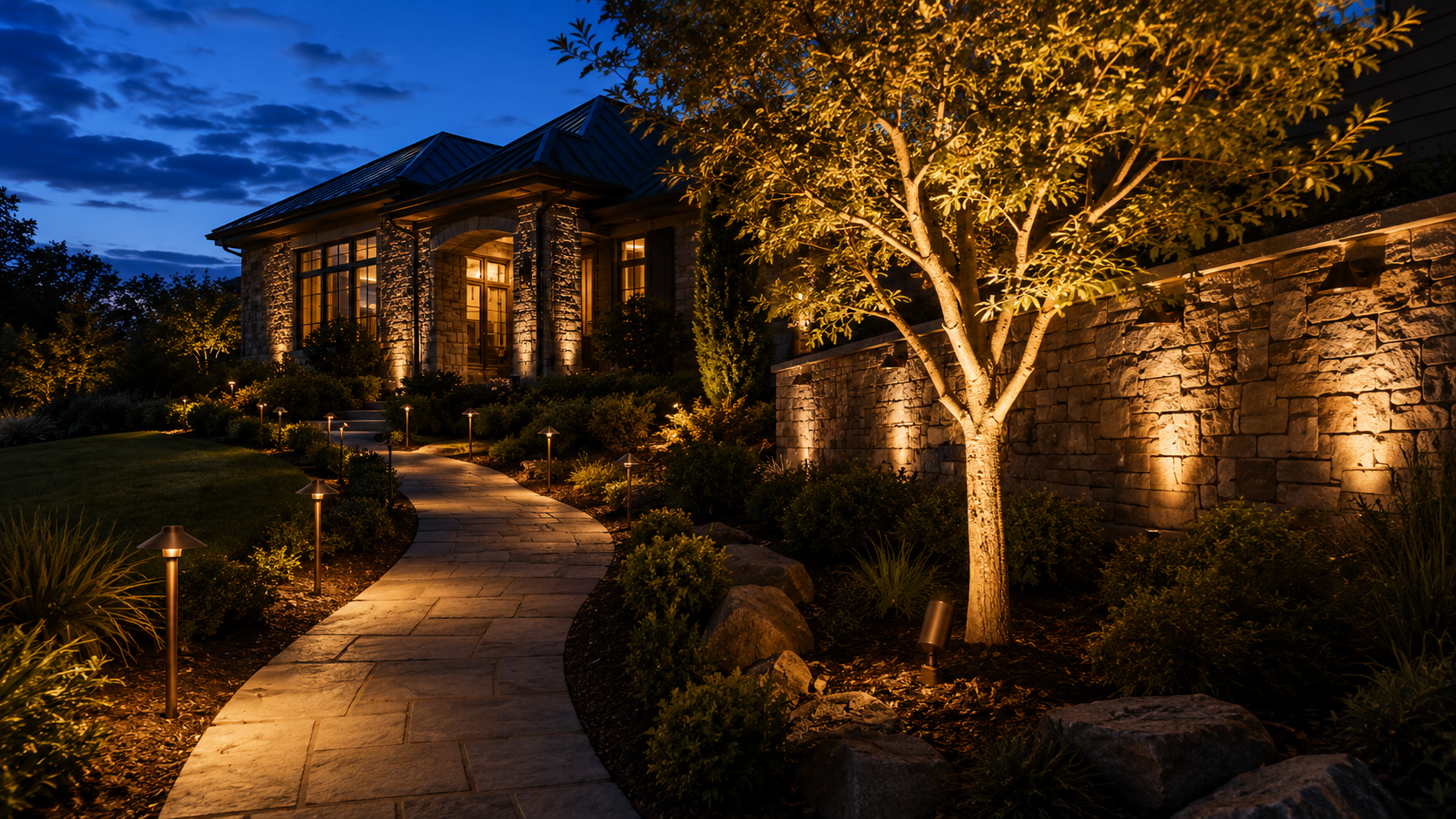
Every landscape lighting design is really a fixture-selection problem. Pick the right type for each part of the property and the job comes together; pick the wrong one and you get glare, dark spots, or a fixture that fails early. Glare in particular is a specification failure, not bad luck: DarkSky International puts it plainly in its five principles — light should be targeted, shielded and aimed so it “does not spill beyond where it is needed,” and at a low level, “no brighter than necessary.” Most of the fixture types below exist to make one of those two things easier.
This guide walks through the main types of landscape lighting fixtures, what each one does, and when to spec it. The profession has its own reference for this, ANSI/IES RP-47-23, Recommended Practice: Landscape Lighting — worth owning if you specify at volume.
Fixtures are only half the equation, though. If you want the effects behind these fixtures, pair this with our landscape lighting techniques guide, and for the material side of the decision, see our brass vs aluminum breakdown. It’s written for contractors and distributors, not homeowners.
The main types of landscape lighting fixtures
Here’s the quick reference. The sections below go deeper on each.
| Fixture | What it does | Best for |
|---|---|---|
| Path light | Casts light down and to the sides | Walkways, borders, garden beds |
| Spotlight / uplight | Narrow beam (15° or 30° in the Dauer MR16 range) aimed at a feature | Trees, statues, architectural details |
| Flood light | Wide beam (60° or 120° in the Dauer MR16 range) over a large area | Facades, driveways, broad coverage |
| Well light | In-ground, flush, aimed up | Uplighting trees and walls with no visible fixture |
| Bollard | Raised post, scatters light around | Open areas, pathways, focal points |
| Downlight | Mounted high, aimed down | Moonlighting, patios, wide soft pools of light |
| Step light | Low, shielded, functional | Stairs, risers, railings, seat walls |
| Hardscape light | Mounts under caps/ledges | Retaining walls, stair treads, kitchen counters |
| Wall washer | Even wash across a surface | Textured walls, stone, facades |
| String light | Overhead, decorative | Patios, pergolas, bistro settings |
Path lights
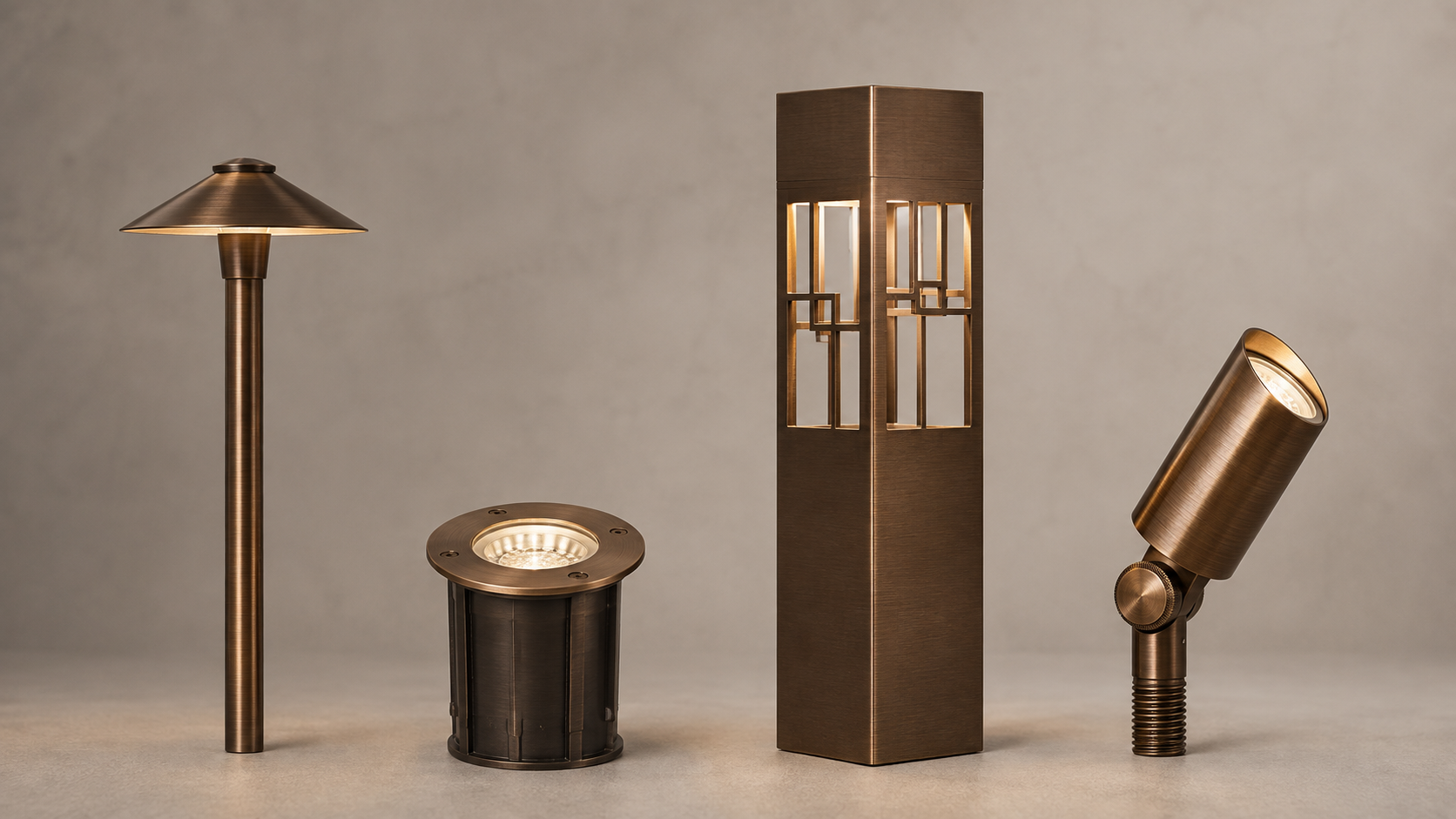
Path lights aim light down and to the sides to cover walkways for both safety and appearance. They’re one of the most-specified fixtures on any job, giving a property visual rhythm along paths, driveways, and garden borders. Mounting height and spacing control how even the coverage looks, so space them to overlap slightly rather than leaving dark gaps between pools of light.
Spotlights and uplights
A spotlight concentrates light into a narrow beam to highlight a specific feature like a tree, statue, or architectural detail. Aim that same spotlight upward from ground level and it becomes an uplight, the workhorse behind tree uplighting and facade illumination.
Beam spread is the spec that matters most here, and it comes from the lamp rather than the housing. The Dauer MR16 7W LED ships in five beam spreads — 15°, 30°, 45°, 60° and 120° — in 2700K and 3000K, at 590 to 615 lumens and 80+ CRI. In practice: 15° for a tall single trunk, 30° for a standard tree, 45° when the canopy is broad, 60° and 120° once you are washing a wall or a facade rather than picking out a feature. The 45° is the one most people forget to spec, and it is usually the right answer on a mature oak.
One more thing the spec sheet settles: the lamp is rated for enclosed fixtures and damp locations, and carries a five-year warranty at more than 50,000 hours. Worth knowing before you bury a fixture in a bed you will not want to reopen.
Well lights
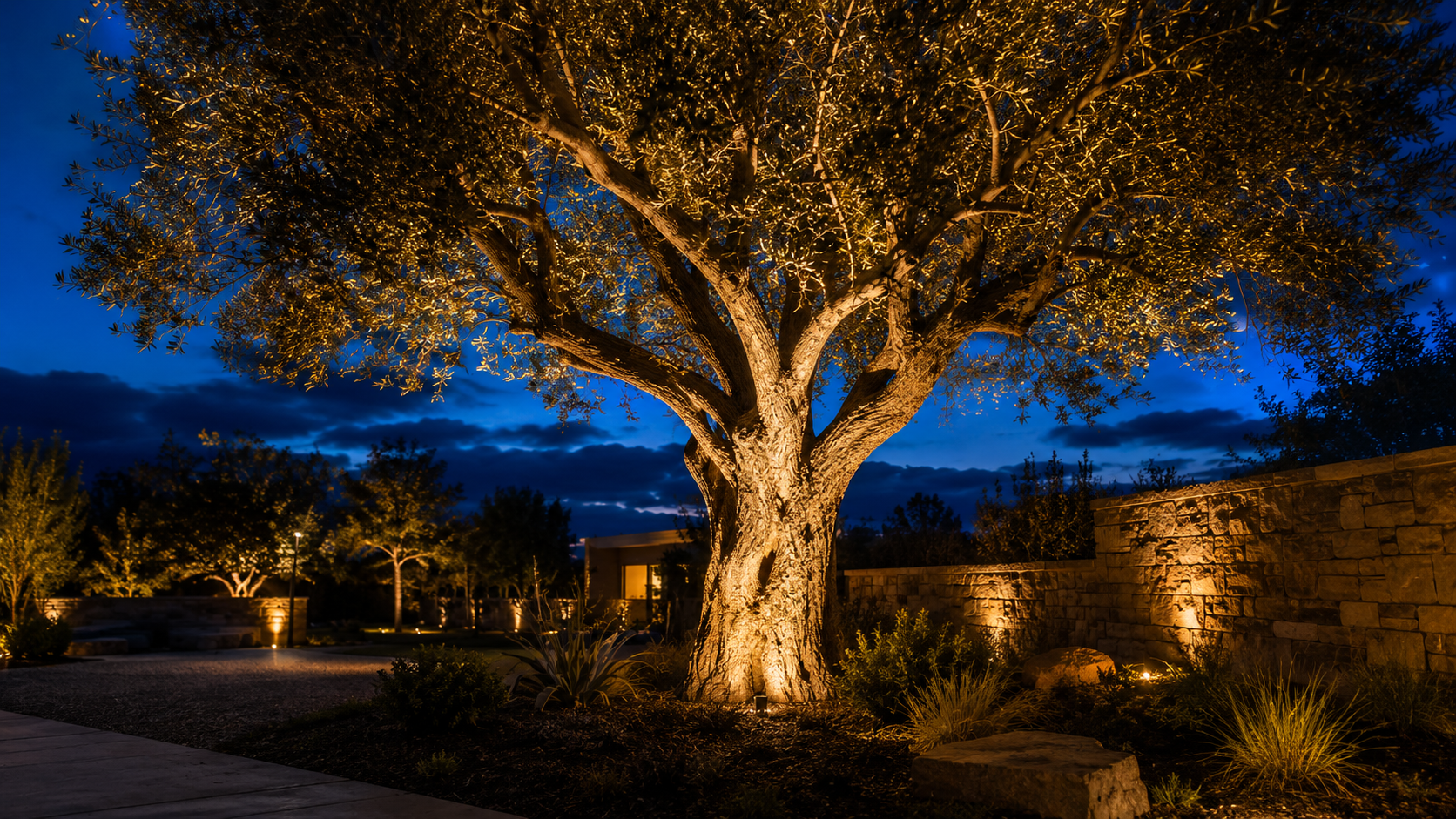
Well lights install in-ground, flush with the surface, and aim straight up. Because the fixture itself disappears, they deliver dramatic uplighting with nothing visible during the day, which is why designers reach for them on clean, modern properties and to light tree trunks, driveways, and building facades. They need proper drainage in the housing, so spec a well light built to shed water.
Two code points are worth knowing before you set one. Low-voltage lighting is defined in NEC Article 411 as operating at 30 volts or less, with peak voltage never above 42.4 volts, and 411.3 requires the system or its parts to be listed. And near water, NEC Article 680 restricts low-voltage lighting within 10 feet of the water’s edge at a pool, spa, or fountain unless that article specifically permits it. Both are free to read on NFPA’s site with a free account. On a pool surround, that 10-foot line decides your layout before aesthetics get a vote.
Bollards
Bollards are raised fixtures, typically from around 10 inches to waist height, that scatter light around their surroundings. They light open areas and pathways and can double as design elements, either subtle and low-key or a deliberate focal point. Dauer’s Silhouette Collection and Minimalist Series bollards are examples of the two ends of that range, one sculptural, one clean and simple.
Downlights and moonlighting
A downlight mounts high, often in a tree or on a structure, and aims down to cast a soft pool of light at the base. Placed high in a tree and angled down through the branches, downlights create the moonlighting effect, a gentle dappled light that reads as natural. Downlights are also used over patios and seating areas where you want wide, comfortable coverage without glare.
Step, hardscape, and specialty lights
Step lights are low, shielded fixtures for stairs, risers, railings, and seat walls, adding safety and a warm glow without a bright source in the eye. Hardscape lights mount directly under wall caps, stair treads, and counter ledges to wash light down a stone or masonry surface. Beyond those, a full line usually includes wall washers and wall sconces, pendants, rail, deck, and dock lights, marker lights, and submersibles for water features. On a commercial or feature-rich property, the job pulls from several of these at once.
String lights
String lights hang overhead to create ambiance over patios, pergolas, and bistro settings. They’re a different category from the directional fixtures above, but on hospitality and outdoor-living jobs they’re often part of the same package. Dauer’s Bistro Boss line covers this end.
Material and light source: two specs that cut across every type
Two specs apply to every landscape lighting fixture regardless of type: material and light source. Material decides how long it lasts: solid brass for coastal and high-exposure sites, marine-grade aluminum where budget leads. The full trade-off is in our brass vs aluminum guide. Light source is drop-in versus integrated: a drop-in fixture uses a replaceable lamp you can swap in the field, while an integrated fixture has the LED built in. On large or hard-to-service sites, drop-in serviceability is often worth it. Both choices sit inside a system, and the standard that governs the system is UL 1838.
Sizing the transformer and reading the IP rating
Two numbers decide whether the install still performs in year three. The first is transformer capacity. Add up the connected wattage of every fixture on the system, add 20 to 30 percent headroom for voltage stability and for fixtures added later, then size so the transformer runs at no more than 80 percent of its rated maximum. A 60-watt load wants at least a 100-watt transformer. The wire gauge and run-distance side of that calculation is in our voltage drop guide.
The second is the IP rating on the housing, which tells you what the fixture keeps out. The first digit covers solids, the second covers liquids: IP65 is dust-tight and protected against water jets, IP67 survives temporary immersion. Well lights and any fixture set where water collects should be spec’d on that second digit, not on appearance.
Trade-grade fixtures and boxed retail kits are not the same spec
A boxed kit and a spec’d fixture are built to different specifications. The kit is priced to sell as a complete package, so the housing is thin, the LED is sealed in and cannot be replaced, and the transformer is sized to exactly the fixtures in the box with no capacity left for a second run. None of that shows up on the day of the install. It shows up when one fixture fails.
On a job you warranty, the real number is not the purchase price. It is the return trip. Trade fixtures use serviceable lamps, heavier brass or aluminum housings, and transformers with headroom, so a failure is a lamp swap at the fixture rather than a dig-out and a replacement.
Where Dauer fits
Dauer Manufacturing manufactures the full range of low-voltage LED landscape fixtures: uplights and downlights, path lights, well lights, bollards, step lights, hardscape lights, wall washers, wall sconces, pendants, rail, deck, and dock lights, marker lights, submersibles, and Bistro Boss string lights. Everything comes in solid brass or aluminum, in drop-in and integrated versions, so a contractor can spec one line across an entire property. Most products can be powder-coated to a custom PMS color, with black available from stock.
The fixtures are backed by a lifetime warranty on brass drop-in fixtures, a ten-year warranty on integrated LED fixtures, a five-year warranty on LED drop-in lamps, and a lifetime warranty on stainless-steel transformers. Marking its 25th Silver Anniversary in 2026, Dauer has manufactured landscape lighting for the trade since 2001.
Frequently Asked Questions About Landscape Lighting Fixtures
What standard covers low-voltage landscape lighting?
UL 1838, Low Voltage Landscape Lighting Systems, is the standard written for this category. It covers the system rather than a single part: the isolating power unit, the wiring, and the luminaires, on circuits rated to a maximum of 25 amps and 300 volt-amperes. It also assumes the system is installed to the National Electrical Code, NFPA 70. When a specification calls for a listed landscape lighting system, UL 1838 is the standard behind that line.
What are the main types of landscape lighting?
The main types are path lights, spotlights and up lights, flood lights, well lights, bollards, downlights, step lights, hardscape lights, wall washers, and string lights. Each is built for a specific job, from lighting walkways to up lighting trees to washing a stone wall.
What is the difference between a spotlight and a flood light?
A spotlight uses a narrow beam spread to pick out a single feature; a flood light uses a wide one to cover a large area such as a facade or driveway. The difference comes from the lamp, not the housing. Dauer’s MR16 7W LED is supplied at 15°, 30°, 45°, 60° and 120° — the 15° and 30° behave as spotlights, the 60° and 120° as floods, and the 45° covers a broad canopy that a 30° would miss.
What is the difference between a path light and a well light?
A path light sits above ground and casts light down and to the sides to illuminate walkways. A well light installs in-ground, flush with the surface, and aims straight up, so the fixture stays hidden while it up lights a tree or wall.
What fixture is used for moonlighting?
Moonlighting uses downlights placed high in a tree and angled down through the branches, casting a soft, dappled light on the ground that mimics natural moonlight.
Can you use one brand of fixtures across a whole property?
Yes, and it is usually the better choice. Specifying one manufacturer’s full range keeps color, quality, and warranty consistent across path, spot, well, step, and hardscape fixtures, and simplifies service and reordering.
Spec the right fixtures for the job
The right landscape lighting job starts with matching each fixture type to its purpose and its location, then choosing a durable material to back it up. For professional-grade low-voltage fixtures across every type, call 1.888.DAUER.LED to reach your authorized Dauer distributor, or visit DauerManufacturing.com. #PowerOfDauer
WRITTEN BY: Tom Rowe is the National Sales Director at Dauer Manufacturing, a US-based manufacturer of low-voltage landscape lighting, commercial lighting and permanent architectural lighting. The company has been manufacturing fixtures, lamps, and transformers wholesale to the trade since 2001. Visit DauerManufacturing.com.