June 30, 2026
Turtle Lighting Requirements: What Contractors Need to Spec on Coastal Jobs
KEY TAKEAWAY: Turtle lighting requirements come down to three rules from the Florida Fish and Wildlife Conservation Commission (FWC): keep it long (wavelength above 560nm, so amber, orange, or red), keep it low (mounted low, at the lowest output that does the job), and keep it shielded (full cut-off, with no lamp or lens directly visible). On most Florida coastal jobs the fixtures also have to satisfy a local sea-turtle ordinance. Spec a fixture that hits all three rules, ideally one that’s already FWC-certified, and the install passes inspection the first time.
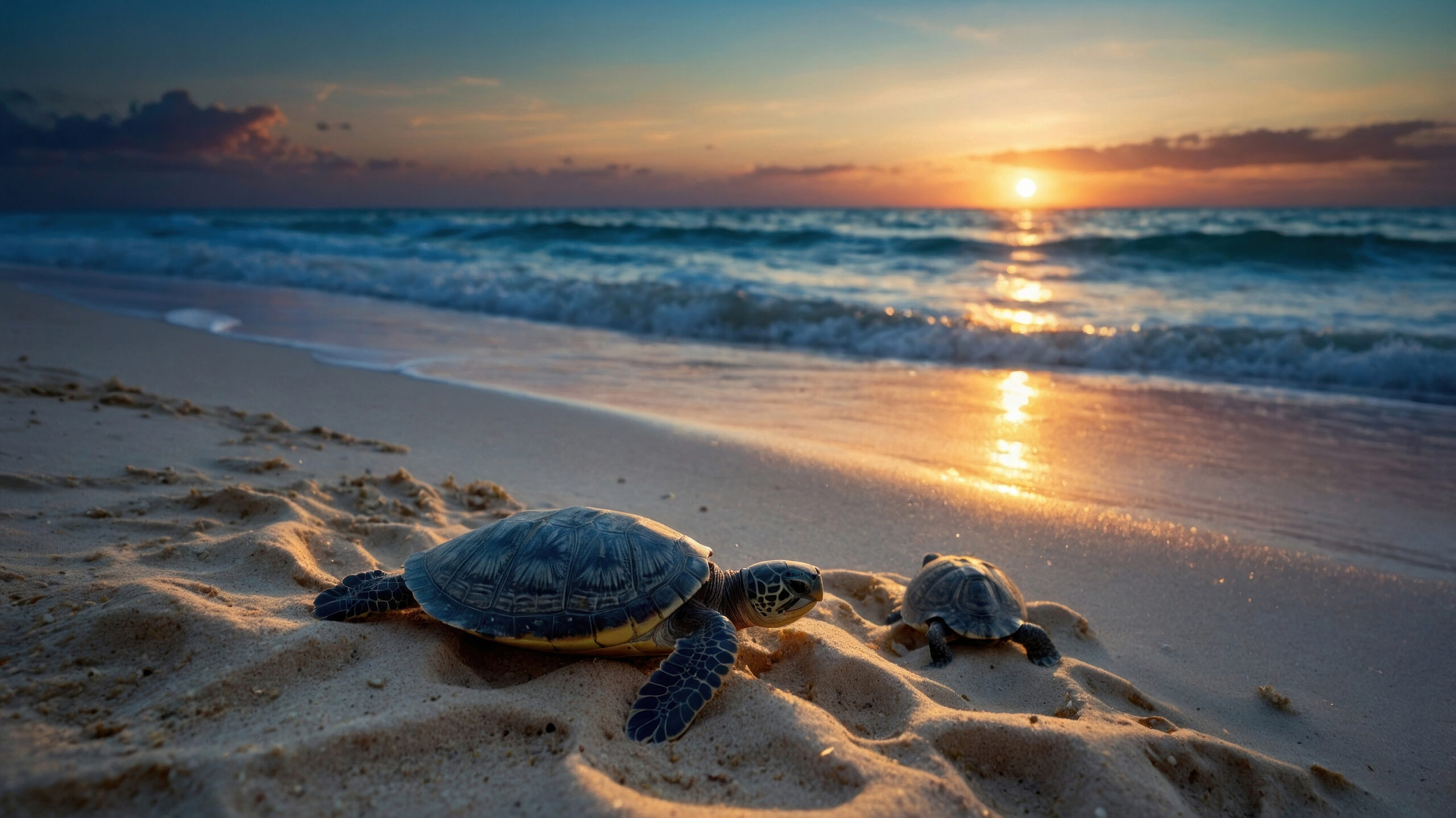
If you install landscape lighting anywhere near a Florida beach, “turtle lighting requirements” aren’t a suggestion. They’re code. Get the spec wrong and you’re looking at a failed inspection, a callback, a torn-out fixture, and in some jurisdictions a fine for the property owner. Get it right and you’ve got a compliant install, plus a reason to charge for specialist knowledge the next contractor down the road doesn’t have.
This guide covers what the requirements are, where they apply, and how to spec a fixture that meets them. For sizing the runs on those coastal installs, it pairs with our voltage drop and wire gauge guide. It’s written for the contractors and distributors who make the call on the job site, not for homeowners.
What “turtle lighting requirements” actually means
Turtle lighting requirements are the standards that keep artificial light from disorienting nesting sea turtles and hatchlings on or near the beach. Hatchlings find the ocean by moving toward the brightest, lowest horizon. Before electric light, that was always the sea reflecting the night sky. Bright, short-wavelength (blue-white) light inland pulls them the wrong way, away from the water, where they die from dehydration, predation, or traffic.
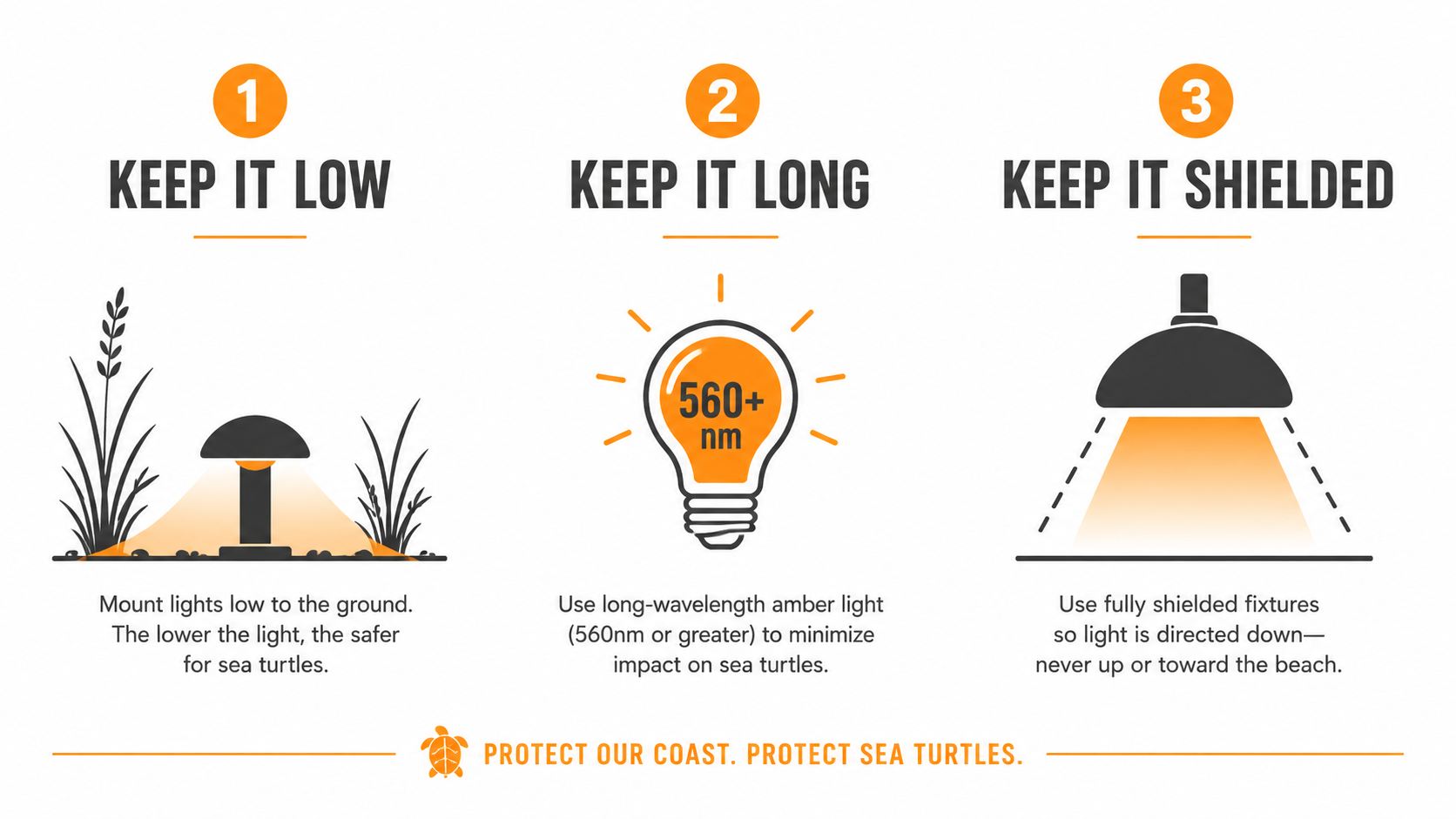
The FWC sums up the fix in three words: Keep It Low, Keep It Long, Keep It Shielded. Every coastal lighting ordinance in Florida is built on those three principles. Once you can spec to all three, you can work any turtle-sensitive job on the coast.
Keep It Long: wavelength above 560nm
This is the rule most fixtures fail. Sea-turtle-safe light has to use a long wavelength, greater than 560 nanometers, which means amber, orange, or red sources. The light should be free of any wavelengths below 560nm, and you can’t fix a non-compliant fixture by clipping on a filter or gel. The source itself has to be long-wavelength amber. A standard 2700K or 3000K warm-white LED will not pass, because it still emits plenty of blue and green below 560nm.
Keep It Low: mounting height and output
Mount the fixture as low as the application allows, and use the lowest wattage or lumen output that still does the job. Bollards, low path lights, step lights, and recessed well lights are the friendly form factors. Tall pole lights and bright floodlights aimed across open sand are not. Less height and less output mean less light reaching the beach.
Keep It Shielded: full cut-off
The fixture has to be shielded so the lamp or glowing lens is not directly visible from the beach, and it must meet or exceed full cut-off, with no light emitted above the 90-degree horizontal plane. Directional, shielded fixtures keep the light on the ground where it belongs instead of throwing it toward the dunes.
Where the requirements apply: Florida coastal ordinances
Turtle lighting requirements are set at the state level and enforced locally. Florida Statute 161.163 directs the Department of Environmental Protection to identify nesting beaches and publish a Model Lighting Ordinance (last substantially updated in December 2020). Counties and municipalities then adopt and enforce their own versions, so the exact rule, and how hard it’s enforced, depends on the jurisdiction.
Coastal counties and beach towns on both coasts have adopted ordinances built on the LOW/LONG/SHIELDED criteria, including Broward, Walton, and municipalities like Fort Myers Beach and Hollywood. Nesting season generally runs March 1 through October 31, and many ordinances apply year-round to new construction and renovations regardless of season.
The practical rule for contractors: before you spec a beachfront or near-beach job, check the local ordinance for that specific county or city. Don’t assume the rule from the last town applies to the next one. When the jurisdiction calls for Certified Wildlife Lighting, that’s the highest level of protection: fixtures and bulbs reviewed and approved through the FWC’s Wildlife Lighting Certification Process. Specifying certified product is the cleanest way to guarantee the install passes.
Compliant vs non-compliant: how to read a spec sheet
When you’re comparing fixtures, these are the lines that decide whether it passes:
| Spec line | ✅ Turtle-compliant | ❌ Will fail inspection |
| Wavelength | ✅ Long wavelength, above 560nm (amber/orange/red) | ❌ 2700K–5000K white LED (emits below 560nm) |
| Source treatment | ✅ Long-wavelength source itself | ❌ White source with a filter/gel “added on” |
| Mounting | ✅ Low: bollard, path, step, well light | ❌ Tall pole, elevated flood |
| Output | ✅ Lowest lumens that do the job | ❌ Maximum brightness “to be safe” |
| Shielding | ✅ Full cut-off, lamp/lens not directly visible | ❌ Exposed lamp, uplight, no cut-off |
| Certification | ✅ FWC-certified wildlife lighting | ❌ No certification, generic “warm” fixture |
If a fixture misses any single row, it isn’t a coastal-job fixture, no matter how good the rest of the spec looks.
How to spec a compliant install: a contractor’s checklist
- Pull the local ordinance for the exact county/municipality and confirm whether certified product is required.
- Spec long-wavelength amber sources (above 560nm) for anything with line-of-sight to the beach, not warm-white with a filter.
- Drop the mounting height. Lean on bollards, path lights, step lights, and well lights instead of poles and floods.
- Right-size the output. Use the lowest lumen package that meets the lighting goal. Over-lighting is the most common ordinance violation.
- Confirm full cut-off shielding so no lamp or lens is directly visible from the beach side.
- Document it. Keep the cut sheets and certification numbers with the job file so the inspector has what they need.
Spec it once, to the ordinance, with the right fixtures, and you skip the rip-and-replace that eats the margin on coastal work. Once the fixtures are compliant, size the wire and transformer so the run actually holds voltage, because a dim run undermines even a perfect fixture (the voltage drop guide linked above walks through the numbers).
Where Dauer fits
Dauer Manufacturing offers an extensive collection of certified Wildlife-Safe lighting approved for coastal and woodland use: amber long-wavelength fixtures and bulbs in low-profile form factors, including Silhouette bollards, path lights, step lights, and well lights, engineered to the FWC’s Low/Long/Shielded criteria. For contractors and distributors, that means a coastal-ready fixture you can spec with confidence, rather than retrofitting a standard warm-white product and hoping it passes inspection.
Dauer is marking its 25th Silver Anniversary in 2026 and has manufactured low-voltage landscape fixtures since 2001. The company is a US-based, professional-grade manufacturer that ships Wildlife-Safe products directly to the trade from their production facility in La Vergne, TN, so the fixtures you spec for a coastal job come straight from the source. If a project needs a custom color or form factor not on the shelf, Dauer powder-coats to a PMS match and manufactures custom on request. If you think it, we can create it.
Frequently Asked Questions About Turtle Lighting Requirements
What wavelength of light is turtle-safe?
Turtle-safe light uses a long wavelength above 560 nanometers: amber, orange, or red. The source should be free of wavelengths below 560nm, and filters or gels added over a white source are not a substitute for a true long-wavelength fixture.
Is red light safe for sea turtles?
Red light falls in the long-wavelength range above 560nm that the FWC identifies as least disruptive, so it is generally considered turtle-safe when the fixture is also mounted low and fully shielded. Amber LEDs are the most common choice because they balance turtle safety with usable visibility for people.
Which Florida counties require turtle-friendly lighting?
Turtle lighting rules are adopted at the county and municipal level under Florida’s state Model Lighting Ordinance, so requirements exist across nesting-beach jurisdictions on both coasts, including Broward, Walton, Fort Myers Beach, and Hollywood. Always confirm the specific local ordinance before specifying a coastal job.
Does amber LED lighting reduce light quality for the property?
No. Long-wavelength amber LEDs deliver clean, usable illumination for paths, steps, and architecture. They render differently than cool white, but for landscape and wayfinding work on coastal properties they provide the visibility the project needs while meeting the ordinance.
Are Dauer’s fixtures certified for turtle-safe use?
Yes. Dauer offers an extensive collection of certified Wildlife-Safe lighting approved for coastal and woodland use, made to the FWC’s long, low, and shielded criteria. Call 1-888-DAUER-LED or talk to a Wildlife-Safe specialist to confirm the right fixtures for your jurisdiction and application.
Spec your next coastal job right
If you’re bidding or building a turtle-sensitive install, get the fixtures confirmed before you order. Talk to a Dauer Wildlife-Safe specialist about certified amber fixtures for your jurisdiction, or call 1.888.DAUER.LED to find your authorized Dauer distributor. Spec it once, get it right, and let the compliant install be your selling point. #PowerOfDauer
WRITTEN BY: Tom Rowe is National Sales Director at Dauer Manufacturing, a US manufacturer of low-voltage LED landscape lighting. The company manufactures fixtures, lamps, and transformers wholesale to the trade, and has since 2001, including a certified Wildlife-Safe line approved for coastal and woodland use. Visit DauerManufacturing.com.