julio 22, 2026
Voltage Drop & Wire Gauge: How Far Can You Run Low-Voltage Landscape Lighting?
KEY TAKEAWAY: Voltage drop is the loss of voltage as current travels down the wire away from the transformer, and it’s the single biggest reason low-voltage landscape lights look dim or uneven. The fix is wire gauge and load management: keep every fixture within 10% of rated voltage (no fixture below 10.8V on a 12V system), use 12-gauge wire for runs up to ~100 feet at 100 watts or less, step up to 10-gauge past ~150 feet, and never load a transformer beyond 80% of its rating. Get those numbers right and the whole install runs bright and even.
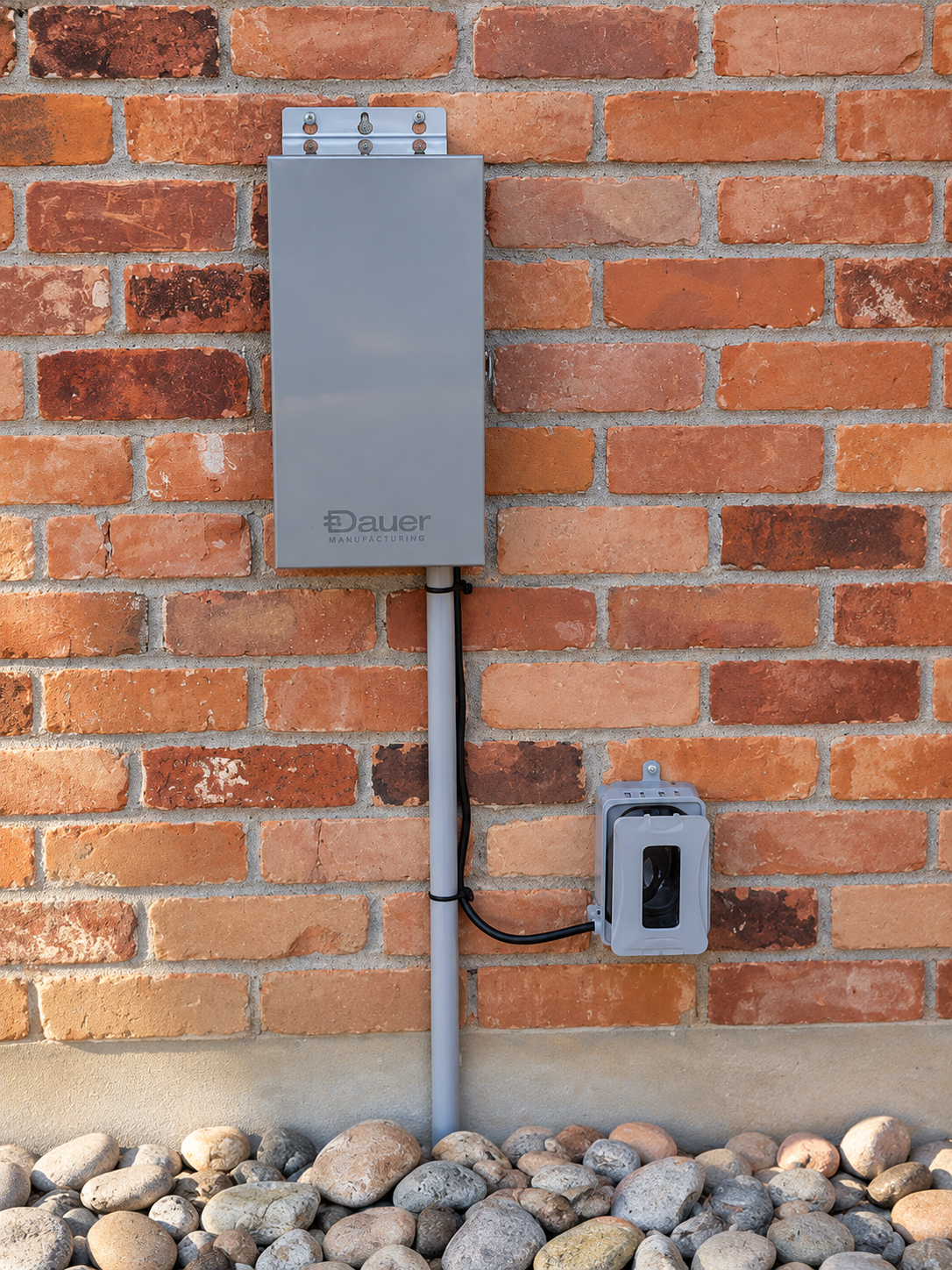
Every landscape lighting callback that starts with «the lights at the end are dim» traces back to one thing: voltage drop. It isn’t a defective fixture and it isn’t a bad transformer. It’s physics, and it’s predictable. This guide gives you the numbers, the wire-gauge chart, and the transformer math to spec a run that holds voltage from the first fixture to the last. It’s written for the contractors and distributors doing the actual layout, not for DIY weekend installs.
What is voltage drop in low-voltage landscape lighting?
Voltage drop is the gradual loss of voltage along a wire run as electrical current meets resistance. The farther a fixture sits from the transformer, the more resistance the current has fought through, and the less voltage reaches that fixture. On a 12-volt system, a light at the end of a long run might only see 9 or 10 volts, and an LED receiving low voltage looks dim, shifts color temperature, or flickers.
The industry standard is to keep every fixture within 10% of the transformer’s rated output voltage. On a 12V system that means no fixture should drop below 10.8V. Stay inside that window and the run looks uniform. Fall outside it and the tail end of the run visibly suffers..
How far can you run low-voltage landscape lighting?
How far you can run depends on three things working together: wire gauge, total wattage on the run, and how the fixtures are distributed. As a working baseline:
- 12-gauge wire carries a run of about 100 feet cleanly as long as the total load on that run is 100 watts or less.
- If the run needs to go beyond ~150 feet, step up to 10-gauge instead of 12. The thicker copper carries the current farther with less loss.
Those are starting points, not hard ceilings. Actual distance shifts with the total wattage and how the load is spread along the wire, which is where wire gauge and wiring method come in.
Wire gauge chart for low-voltage landscape lighting
Mount the fixture as low as the application allows, and use the lowest wattage or lumen output that still does the job. Bollards, low path lights, step lights, and recessed well lights are the friendly form factors. Tall pole lights and bright floodlights aimed across open sand are not. Less height and less output mean less light reaching the beach.
Keep It Shielded: full cut-off
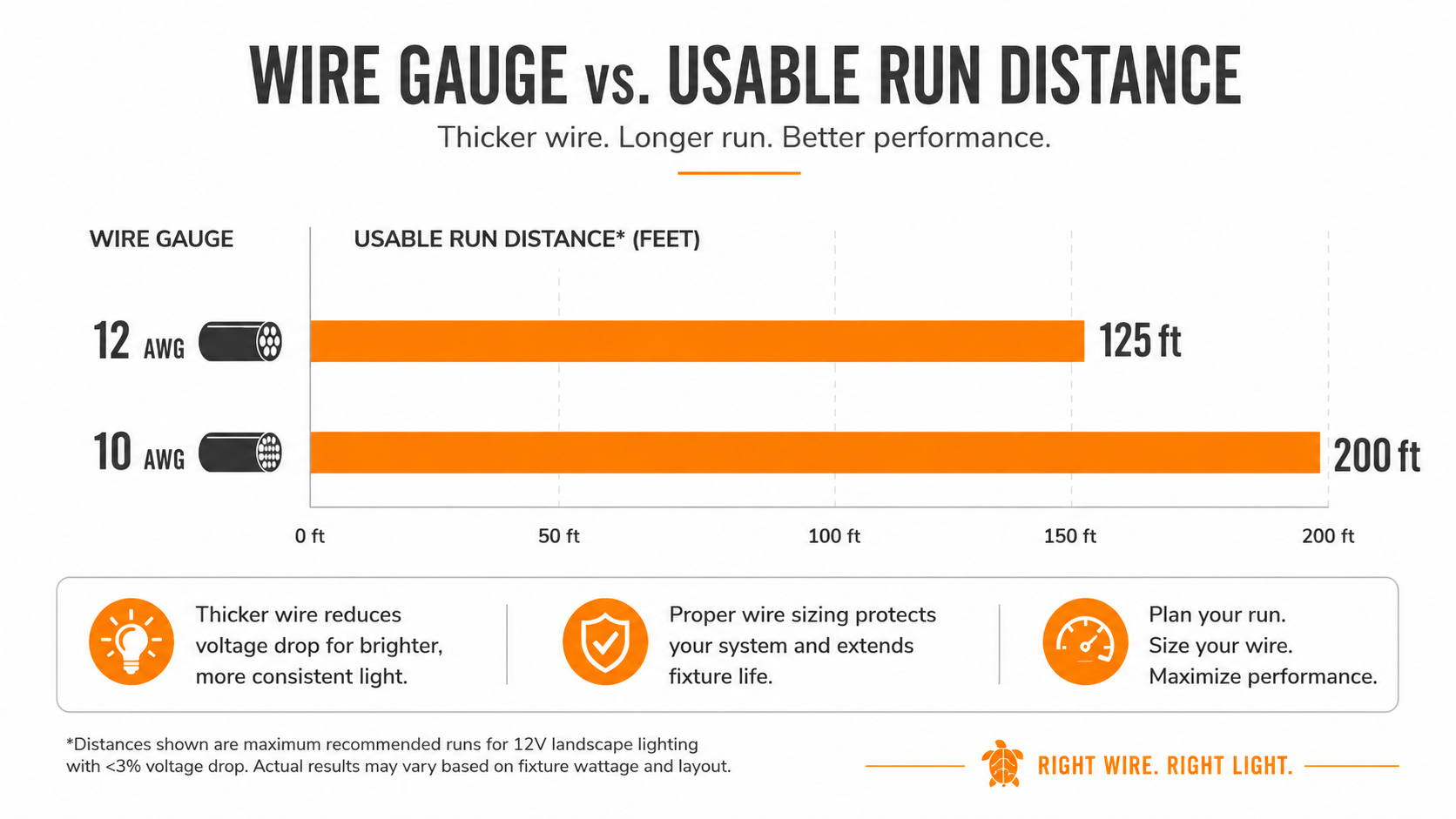
Lower gauge number = thicker wire = less voltage drop over distance. A quick reference for landscape runs:
| Wire gauge | Typical load | Approx. usable run* |
|---|---|---|
| 12 AWG | ~100 W | Up to ~100 ft clean |
| 10 AWG | Heavier / long runs | Best past ~150 ft |
*Usable run depends on total wattage on the circuit and load distribution, so always calculate for the actual layout. When in doubt, go one gauge heavier. Thicker wire is cheap insurance against a callback.
Wiring methods that beat voltage drop
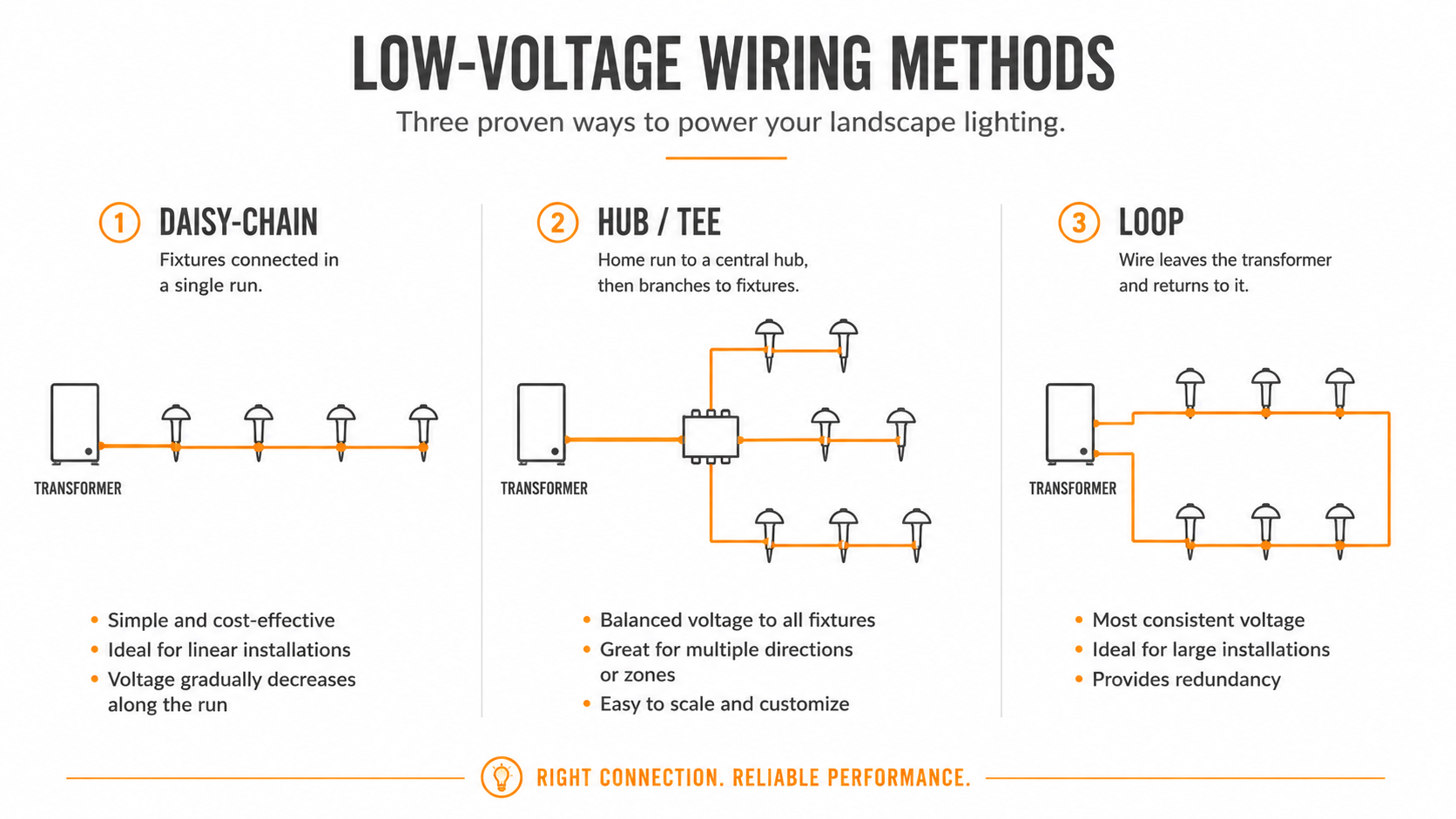
How you route the wire matters as much as its gauge:
- Daisy-chain (run): simplest, but voltage drops steadily down the line. Fine for short runs with few fixtures.
- Hub / tee method: wire branches out to small clusters, evening out the distance from the transformer to each fixture.
- Loop method: the run returns to the transformer, feeding fixtures from both directions and cutting end-of-run drop.
For longer or fixture-heavy designs, hub and loop layouts hold voltage far better than one long daisy-chain.
What size transformer do I need for landscape lighting?
Size the transformer off the total connected load, then build in headroom. Add up the wattage of every fixture on the system, then add 20–30% overhead for voltage stability and future additions. The key rule: never load a transformer beyond 80% of its rated maximum. That 80% derating accounts for transformer inefficiency and protects against overload.
Worked example: 12 fixtures × 5W = 60W connected load. Add 25% headroom and you’re at 75W. To keep that at or under 80% capacity, you’d spec at least a 100W transformer (75 ÷ 100 = 75% load). Specifying a 75W transformer for a 60W load leaves no room and runs hot.
A multi-tap transformer (12V/13V/14V/15V taps) gives you another lever. Feeding a long run from a higher tap compensates for the drop, so the far fixtures still land in the 10.8V+ window.
A contractor’s voltage-drop checklist
Add up the connected wattage for each run and for the whole system.
Pick wire gauge for the run length and load: 12-gauge to ~100ft/100W, 10-gauge past ~150ft.
Choose a wiring method: hub or loop for long or fixture-heavy designs, not one long daisy-chain.
Size the transformer at total load plus 20–30%, loaded to no more than 80% of rating.
Use the taps. Feed long runs from a higher voltage tap to offset drop.
Verify under load. Meter the voltage at the first and last fixture, and keep every fixture at 10.8V or above on a 12V system.
Run those six steps and the install holds voltage end to end. No dim tail, no callback.
Why the fixture and transformer quality matter
Voltage-drop math only holds if the hardware is built to spec. Thin wire, undersized transformers, and loose connectors all add resistance the calculator didn’t account for. And on coastal jobs, the fixtures themselves have to clear turtle lighting requirements (long-wavelength amber, mounted low, fully shielded) before voltage drop is even in the picture. Dauer Manufacturing has built low-voltage landscape fixtures and transformers in the USA for 25 years: drop-in and integrated LED fixtures in brass and aluminum, plus transformers sized for real-world trade installs. Everything ships direct to the trade from inventory, backed by a 98% ship rate, so the gauge of wire and size of transformer you spec are available when the job is on the clock.
If a layout needs a fixture or finish that isn’t on the shelf, Dauer powder-coats to a PMS match and builds custom. If you think it, we can create it.
How Dauer integrated fixtures help eliminate voltage drop
One advantage of Dauer’s integrated LED fixtures is the use of constant current LED drivers. Unlike conventional lighting that can show noticeable changes in brightness as voltage fluctuates, a constant current driver automatically adjusts the voltage while maintaining a steady current to the LED. That means the fixture delivers consistent light output across a wider input voltage range, helping minimize the visible effects of voltage drop on longer wire runs. While proper wire sizing, transformer selection, and system design are still essential, Dauer’s integrated fixtures provide an added layer of performance by maintaining more consistent brightness, improving reliability, and helping protect the LED for a longer service life.
If a layout needs a fixture or finish that isn’t on the shelf, Dauer powder-coats to a PMS match and builds custom. If you think it, we can create it.
Frequently Asked Questions
How far can you run 12-gauge low-voltage landscape lighting wire?
About 100 feet, as long as the total load on that run is 100 watts or less. Past roughly 150 feet, step up to 10-gauge wire to keep voltage drop within the acceptable range.
What is acceptable voltage drop for landscape lighting?
Match the gauge to run length and load: 12-gauge for runs around 100 feet at 100 watts, and 10-gauge for runs beyond 150 feet. When in doubt, go one gauge heavier.
What size wire do I need for low-voltage landscape lighting?
Turtle lighting rules are adopted at the county and municipal level under Florida’s state Model Lighting Ordinance, so requirements exist across nesting-beach jurisdictions on both coasts, including Broward, Walton, Fort Myers Beach, and Hollywood. Always confirm the specific local ordinance before specifying a coastal job.
What size transformer do I need?
Add up the total fixture wattage, add 20–30% for headroom, and size so the transformer runs at no more than 80% of its rated capacity. A 60W load wants at least a 100W transformer.
Why are the lights at the end of my run dim?
That’s voltage drop: the far fixtures are receiving less than 10.8V. The fix is heavier-gauge wire, a hub or loop wiring layout, feeding the run from a higher transformer tap, or reducing the load on that circuit.
Spec it tight, the first time
Voltage drop is predictable, so price the wire and transformer for the run, not the bare minimum. For low-voltage fixtures and correctly sized transformers shipped direct to the trade, call 1.888.DAUER.LED to reach your authorized Dauer distributor, or visit DauerManufacturing.com to spec your next install. #PowerOfDauer
WRITTEN BY: Tom Rowe is the National Sales Director at Dauer Manufacturing, a US-based manufacturer of low-voltage landscape lighting, commercial lighting and permanent architectural lighting. The company has been manufacturing fixtures, lamps, and transformers wholesale to the trade since 2001. Visit DauerManufacturing.com.